
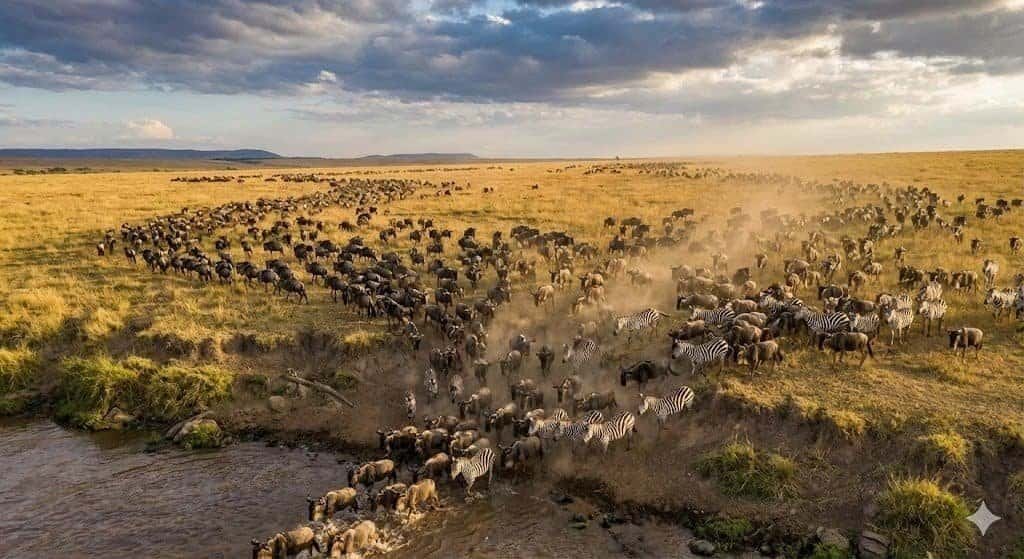
Plan your Great Migration safari: the herds usually reach the Maasai Mara in July, but rainfall shapes their movements and river crossings cannot be promised. Explore the seasonal route, historical patterns and places to stay.
What matters when planning a migration safari?
Timing varies
July is the usual arrival month. Rain can move the herds out of the Mara during the season.
Location matters
Choose a stay for access to the areas you want to explore, rather than a promise of a crossing.
Keep your plans flexible
Allow time for the river and the plains. A migration safari offers more than a crossing.
Explore the Great Migration on the map
The migration, month by month
A real geographic map with a seasonal outlook drawn from verified historical patterns.
The outlook follows the selected month automatically. Historical patterns are not current sightings. Crossings depend on wildlife behaviour and conditions. Markers identify geographic references; park outlines come from OpenStreetMap.
What is the Great Migration?
The Great Migration is the seasonal movement of wildebeest and other grazing animals through the Serengeti–Mara ecosystem in Tanzania and Kenya. It follows changing grazing and water availability. The famous Mara River crossings are part of that wider movement, alongside grazing herds, the journey north and calving on the southern Serengeti plains.
For a Kenyan safari, the useful question is when the migratory herds reach the Maasai Mara and which areas they use. July is the usual arrival month, followed by a variable period in the Mara. Their movements can reverse after rain, and groups may spread across different areas. A calendar helps you choose a travel window; it cannot tell you where every herd will be on your arrival day.
Keep the geography clear when comparing trips. The southern Serengeti calving grounds are in Tanzania. The Maasai Mara is the Kenyan part of the ecosystem. A safari focused on the Mara is different from a Tanzania calving safari, even though both experience the same migration cycle. Start with the timing and area you want, then compare accommodation and transport.
How does the seasonal route work?
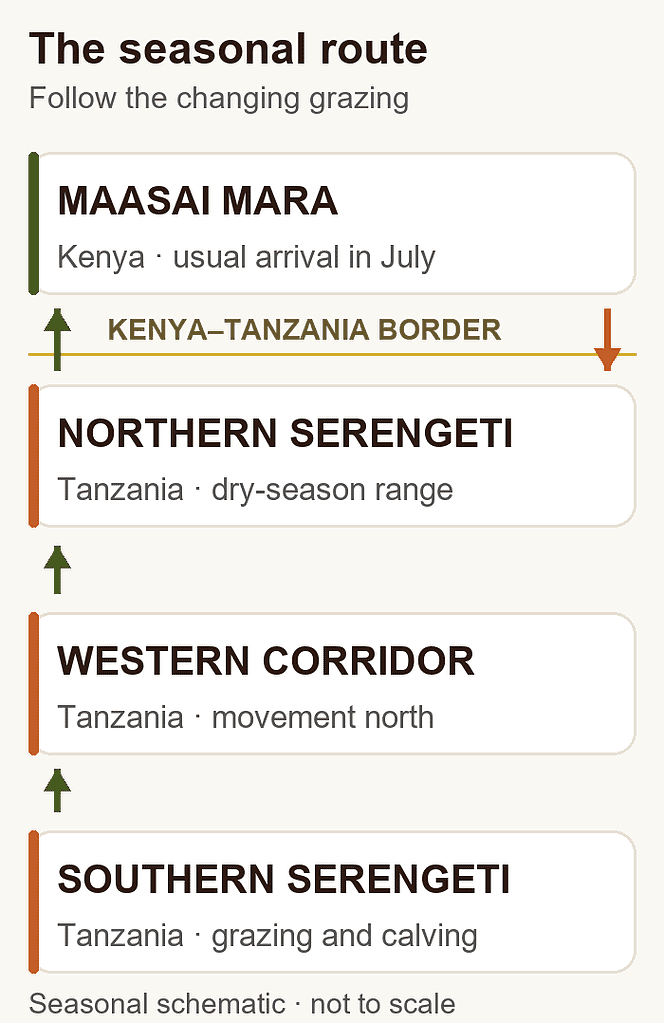
The migration route links the southern Serengeti wet-season grazing grounds with the Western Corridor, northern Serengeti and Maasai Mara. As conditions change, the animals move towards suitable grass and water, then return south with the rains. The diagram shows the broad seasonal sequence and the countries involved.
Read it as a route schematic, rather than a navigation map or a line followed by every animal. Herds split, linger and double back. The Mara River runs through the northern part of the ecosystem, so seeing a Mara River crossing in Tanzania and watching one in Kenya are different safari arrangements.
For a Maasai Mara trip, your accommodation, road access and daily guiding shape which areas you can explore. Avoid choosing a camp only because a map places a river nearby. Ask how its game drives reach the relevant viewing areas and how the itinerary can respond to changing observations.
Great Migration calendar month by month
This Great Migration calendar describes the broad seasonal pattern, not a forecast. The Tanzanian parts of the cycle help explain where the migratory herds may be when they are outside Kenya. The Maasai Mara still offers resident wildlife throughout the year; a trip outside the migration window can have a different focus.
| Month | Broad seasonal pattern | Planning a Maasai Mara visit |
|---|---|---|
| January | Southern Serengeti wet-season grazing; calving begins towards the end of the month | Plan for resident Mara wildlife. A calving-focused migration trip belongs in Tanzania. |
| February | Calving on the southern Serengeti short-grass plains | Do not expect the Serengeti migratory herds in Kenya because a trip is sold as a migration safari. |
| March | Southern Serengeti grazing and the later part of calving | Choose the Mara for its resident wildlife and a Tanzania itinerary for the southern migration grounds. |
| April | The southern wet-season range remains important | Consider the long rains when planning drives and accommodation; confirm the camp is operating. |
| May | Movement west and north develops as the dry season begins | Treat migration arrival as uncertain; build a Kenyan trip around wildlife already in the Mara. |
| June | Western Corridor movement; early arrivals in Kenya occur in some years | An early arrival is possible, but July is the more usual Mara arrival month. |
| July | Movement into the northern ecosystem and usual arrival in the Mara | Confirm whether observations refer to the Main Reserve, the Triangle or Tanzania. |
| August | Herds may use the Mara and northern Serengeti; rain can send them south again | Keep your days flexible and consider access to both the river and plains. |
| September | The northern ecosystem remains relevant, with large differences between years | Read dated reports. A seasonal description alone does not establish herd presence in Kenya. |
| October | Herds may remain, return or move south as grazing and rain change | Avoid assuming a late-season visit will include a crossing; plan for wider wildlife viewing. |
| November | The return towards southern grazing grounds develops with the rains | Use the latest observations; the Kenyan migration window may already have closed. |
| December | The southern Serengeti becomes the focus of the wet-season cycle | Plan a Mara safari around resident wildlife, or compare a Tanzania itinerary for the migration. |
For weather, crowds and other safari priorities, compare the best time to visit the Maasai Mara. Camp price seasons and park fee seasons are separate considerations; use the safari cost guide for current planning detail.
What do past seasons tell us?
The Mara Conservancy’s reports show different arrival and departure patterns from one season to the next. These historical observations explain the uncertainty in planning; they do not predict the next season. Arrival in the Main Reserve and a crossing into the Triangle are separate events.
| Season | Recorded movement | Lesson for planning |
|---|---|---|
| 2023 | First arrivals in July; the Conservancy reported that all had left before the end of September | A September booking does not establish that the herds will remain throughout the month. |
| 2024 | First crossings into the Triangle on 20 July; few remained by 20 August; large numbers returned in September | Movement can reverse. A quiet spell can be followed by a return. |
| 2025 | Entry over the Sand River on 6 July; a later return to the Triangle in October; some remained until 30 October | A single arrival date does not describe the whole season or every part of the Reserve. |
| 2026 | First Sand River crossing into the Main Reserve on 28 June; an August storm sent herds south; September concentrations were reported along the Western Serengeti boundary | An early start does not guarantee a long stay in the Kenyan part of the ecosystem. |
Can you guarantee a Mara River crossing?
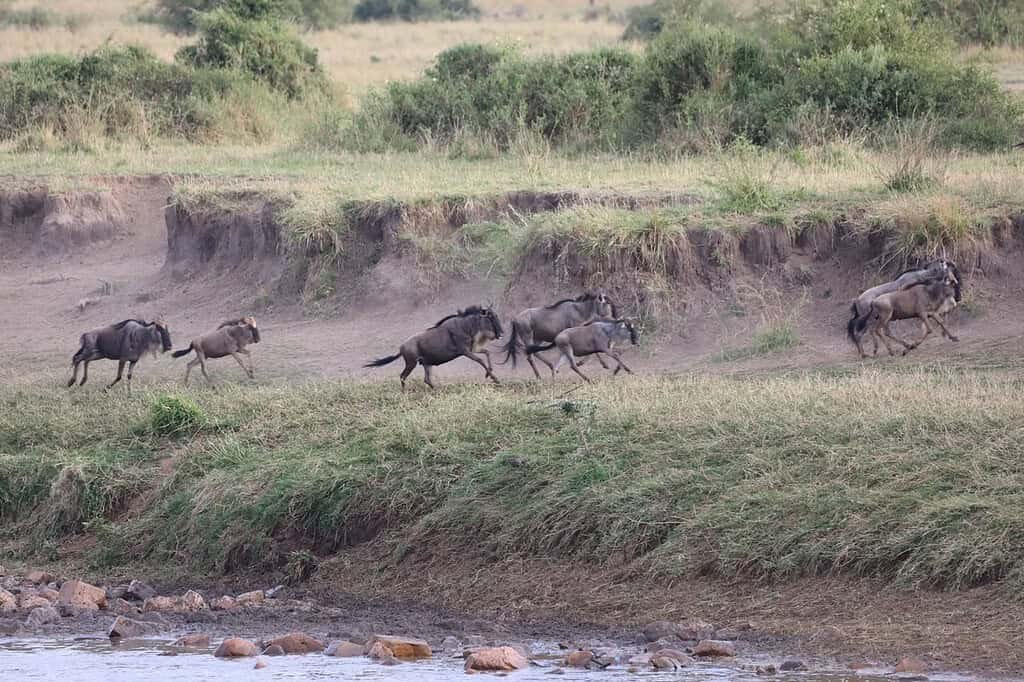
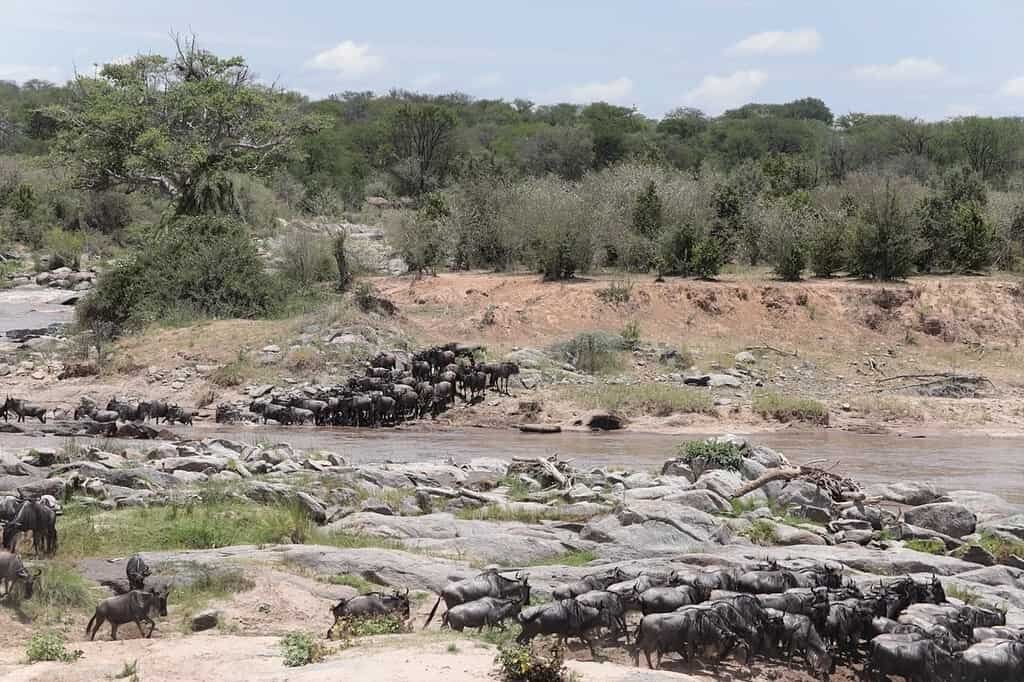
River crossings are difficult to predict, even when the migration is present. Animals can gather at a riverbank without crossing, change direction or cross where your vehicle is not positioned. Being beside the river is an opportunity to observe that behaviour, rather than an appointment with a scheduled event.
Plan a safari that remains worthwhile if no crossing happens during your visit. Grazing herds, movement across the plains and the Mara’s resident wildlife provide other ways to experience the ecosystem. Discuss how much of each day you want to spend waiting at the river and how much you want to spend exploring.
A flexible guide can respond to observations and ranger directions, but cannot control the animals. Be wary of a daily crossing promise, a precise crossing probability or an itinerary claiming to put every visitor in the right place at the right moment. Allow room for wildlife behaviour in your expectations.
The same principle applies to timing within the day. There is no guaranteed crossing hour. A guide’s decision about when to approach a site should reflect conditions, safe access and the animals’ behaviour, rather than a fixed instruction to arrive at a particular hour.
Which crossing areas should you understand?
| Area or name | Why it matters | What to confirm |
|---|---|---|
| Sand River | A border-area river where entry into the Main Reserve has been reported | A Sand River crossing is distinct from a Mara River crossing. Wildlife movement does not provide permission for visitors to cross the international border. |
| Mara River and the Triangle | Reports name Look Out, the U crossing and Main Crossing above Serena | Ask which river section your camp’s drives can reach and where recent observations were made. |
| Other reported Mara River sites | Reports also use names such as Double Crossing and locations near Kichwa airstrip | Local naming varies. Confirm the location and current access with your guide rather than treating a name as a booked viewpoint. |
These are reported places, not a list of guaranteed viewing sites. Access and suitable viewing positions depend on conditions and ranger guidance. Stay on authorised routes and respect the Kenya–Tanzania boundary.
How do you watch without disturbing the herds?
- Stay inside your vehicle at river crossing points.
- Keep the animals' approach and exit routes clear; do not park too close or block a crossing.
- Never drive through a herd, chase animals or use the vehicle to push them towards the river.
- Speak quietly; avoid shouting, cheering and clapping.
- Do not stand or sit on the vehicle roof or sit in a window to photograph a crossing.
- Follow ranger directions and the rules of the area you are visiting.
Why is patience part of the experience?
A herd gathering near water is wildlife behaviour to watch in its own right. Waiting can reveal how animals approach, retreat and follow one another. A respectful viewing position leaves them space to make that decision. Moving closer to force a better photograph can interrupt the movement you came to see.
Agree expectations with your guide before the drive. Explain whether your priority is a crossing, wide landscape photography, time with the herds or a varied day of wildlife viewing. You can then balance waiting and exploration without treating a safari as a checklist that the animals must complete.
Keep cameras and binoculars ready, but make the day comfortable enough for a period of waiting. Ask the organiser about shade, drinking water, meals and planned stops. The right preparation lets you observe patiently and follow the guide’s directions when the situation changes.
Where should you stay for a migration safari?
Choose accommodation by its location, daily game-drive arrangements and the experience you want. A riverbank setting, an attractive room or a conservancy address does not by itself establish access to a crossing. Compare the actual driving arrangements before committing to a stay.
| Stay location | Planning advantage | Questions before booking |
|---|---|---|
| Main Reserve | A base within the Kenyan Reserve for wildlife drives | Which river sections and plains does the camp use? How flexible are its daily drives? Which fees are included? |
| Mara Triangle | A base in the western part of the Reserve managed by the Mara Conservancy | How does the camp reach the relevant river areas? Confirm the ticket arrangements and itinerary rather than assuming access from a map. |
| Surrounding conservancies | A different wildlife experience that can complement time in the Reserve | Does the itinerary include Reserve visits? What are the transfer and fee arrangements? Conservancy wildlife is not proof of Serengeti migratory herd presence. |
| Outside a Reserve gate | A base with entry through the relevant gate for Reserve visits | Which gate will you use? How much driving is involved before reaching the viewing area? Confirm entry arrangements and the shape of each day’s drive. |
Browse Maasai Mara accommodation for the types of stay available. When comparing quotes, ask for the camp name, area, board basis, transport and fee inclusions in writing. The best choice is the one that fits your priorities and itinerary.
How should you plan your safari days?
Start with your available dates and your main interest. If a crossing is the priority, make that clear, while accepting that the outcome remains uncertain. If photography matters, explain whether you prefer landscapes, behaviour or a broader wildlife portfolio. Those choices affect the pace of the days and the kind of guiding you need.
Next, compare how much of the itinerary is actually available for game viewing. Road travel and flights organise arrival and departure differently. A short itinerary can still be enjoyable, but it offers less flexibility to change plans after a quiet period at the river. Read the day-by-day schedule rather than comparing trip names alone.
Ask what happens when the migratory herds are away from the camp’s usual drive area. A useful answer explains the available alternatives, any limits on access and how the guide decides where to go. It should not promise a move to any location across the ecosystem regardless of country, distance or permissions.
Finally, check inclusions. Private and shared arrangements, accommodation, meals, transfers and park or conservancy fees can make similarly named safaris quite different. Use the safari planning guide to organise those decisions before requesting a tailored proposal.
What should you arrange before travelling?
Choose between travel to the Mara by road and flights to the Maasai Mara using the full itinerary. Confirm the pickup point, accommodation, airstrip or gate, and transfers. Avoid assuming that a flight arrival puts you beside a crossing or that a road transfer includes a wildlife drive.
Pack for time in a safari vehicle: layers, sun protection, a rain layer, binoculars, camera equipment and a way to protect it from dust. Confirm baggage restrictions with your airline if flying. Ask the organiser about meals and stops on longer drives, rather than relying on the availability of facilities near a riverbank.
Check the Reserve entry fees and rules and which charges your quote includes. Tickets are bought through the KAPS ticket portal. Your organiser should explain the arrangements for the parts of the Reserve and any conservancies in your itinerary.
For an international trip, review Kenya entry requirements before booking travel. A combined Kenya and Tanzania safari needs arrangements for both countries. Watching animals cross a river or the border does not give visitors permission to follow them across an international boundary.
Great Migration questions travellers ask
Is July to October a guaranteed migration season in Kenya?
No. July is the usual arrival month, and the northern part of the ecosystem is important during the dry-season movement. The Mara Conservancy’s reports show that rain can send herds out of Kenya temporarily, and departure dates vary. Use that window as a planning guide, then check the dated observations relevant to your trip.
Can seasonal patterns show where the herds are today?
Historical records help explain the areas used in different months and how conditions can change the migration. They do not establish today’s herd position. Use a seasonal pattern to plan a travel window, then confirm recent observations for the areas your safari will visit.
Are all wildebeest in the Mara part of the same migration?
The ecosystem includes the Serengeti migratory herds and Kenya’s Mara–Loita wildebeest population. Seeing wildebeest in a conservancy does not by itself mean the Serengeti migration has arrived there. Ask which herd and area an observation describes before using it to choose accommodation.
Can I see the migration without a river crossing?
Yes. The migration also includes herds grazing and moving through the landscape. A crossing is one part of the cycle. Discuss a mix of river time and plains exploration with your guide so the itinerary reflects your wider interests.
Should I choose a camp beside the river?
A useful location can help organise drives, but proximity is only part of the decision. Compare the river sections reached, authorised access, guiding, transfers and inclusions. A riverfront room is not a guarantee that the animals will cross in view during your stay.
Can I follow the herds from Kenya into Tanzania?
A combined safari needs an arranged international journey and the relevant entry permissions. Do not cross the border during a Kenyan game drive. Tell the organiser if you want both countries included so the travel, accommodation and paperwork can be planned properly.
Is the Mara worth visiting when the migratory herds are away?
The Maasai Mara has resident wildlife outside the Serengeti migration period. Choose the visit for those interests and the experiences available where you stay. Explore the Mara activities guide and safari questions and answers to shape a trip beyond the river crossings.
Explore safari packages






From USD 2,000 per person sharing



From USD 2,350 per person sharing

From USD 1,950 per person sharing

From USD 2,350 per person sharing

From USD 1,700 per person sharing

From USD 2,900 per person sharing

From USD 3,800 per person sharing
Plan your Great Migration safari
Tell us your dates or preferred month, travellers, budget range and whether you favour road travel or flights. Include your wildlife and photography priorities, and we will help arrange a proposal through our authorised tour operator partners.
Your proposed camps, transport and inclusions will be set out for your dates. River crossings remain a wildlife event that cannot be promised.
