
Maasai Mara in August: weather, wildlife, crowds and prices
Maasai Mara in August means the wildebeest herds in the Mara for at least part of the month, the busiest roads of the year and the high-season park fee.
The wildebeest herds were in the Maasai Mara in early August in every year from 2023 to 2026, and August is the Mara Triangle’s busiest month. Rain often sends the herds back to Tanzania for a while: hardly any were left by 20 August in 2024, heavy rain from 9 August emptied the Mara within days in 2025, and a storm on 17 August pushed them south in 2026. The month is in the dry season, but rain varies: around 5 mm at Serena in 2023, 85.7 mm in the Triangle in 2024. The park fee is in its high season, USD 200 per non-resident adult a day.
Park tickets for both the Main Reserve and the Mara Triangle are sold on the KAPS ticket portal.
The observations below come from the Mara Conservancy, which manages the Mara Triangle, and from Governors’ Camp at Musiara, in the north of the Reserve, for each August from 2023 to 2026.
Maasai Mara in August at a glance
Rain: about 5–85.7 mm
Mara Triangle totals for 2023 and 2024; Governors' Camp recorded 81–84 mm in 2024–2025.
Mornings 11–15 °C, days 25–28 °C
Recorded at Governors' Camp, Musiara, in 2025.
Herds in, then often out
Rain sent them back to Tanzania for a while in 2024, 2025 and 2026.
High-season park fee
USD 200 per non-resident adult a day, 1 July to 31 December.
The busiest month
41,992 visitors to the Mara Triangle in 2023, its record.
Quieter in the last week
Visitor numbers fell from the last week of the month in each of 2023–2026.
What is the weather like in the Maasai Mara in August?
Long-term Mara rain-gauge records place August in the dry season (July–October), when months average 53 mm of rain, but recent years have varied. The Mara Conservancy called July and August 2023 the driest since it began in 2001, with around 5 mm at Serena that August. Its year-end chart gives 85.7 mm for the Triangle in 2024; Governors’ Camp at Musiara recorded 84 mm that year, almost triple its total a year earlier, and 81 mm in 2025. In 2026 the Conservancy described a month that was dry throughout, with occasional showers and one or two storms that did not turn the grass green.
Mornings are cool and the days warm. Governors’ Camp recorded mornings of about 13 °C and days of about 25 °C in 2024, and days of 25–28 °C, mornings and evenings of 11–15 °C and about 7–8 hours of sunshine a day in 2025. Pack a warm layer for early drives and a light waterproof for storms. Our Maasai Mara weather guide compares every month.
How much rain fell in recent Augusts?
Measured totals for the month, in millimetres, at two gauges in different parts of the Mara.
| Year | Mara Triangle (Serena) | Governors' Camp, Musiara | What it meant |
|---|---|---|---|
| 2023 | Around 5, at Serena | No figure | With July, the driest since the Conservancy began in 2001; the herds arrived early in the month |
| 2024 | 85.7 | 84, almost triple the year before | A storm on the 3rd and rain from the 9th to the 16th; hardly a wildebeest left by the 20th |
| 2025 | No total given | 81 | Very heavy rain from the 9th flooded the river and sent the herds back to Tanzania |
| 2026 | No total given; dry throughout | No figure | One or two storms; one on the 17th pushed the herds back south |
The 2024 Mara Triangle figure comes from the Conservancy’s year-end rain chart, which is titled “Rainfall 2025” but holds the 2024 data.
Where is the migration in August?
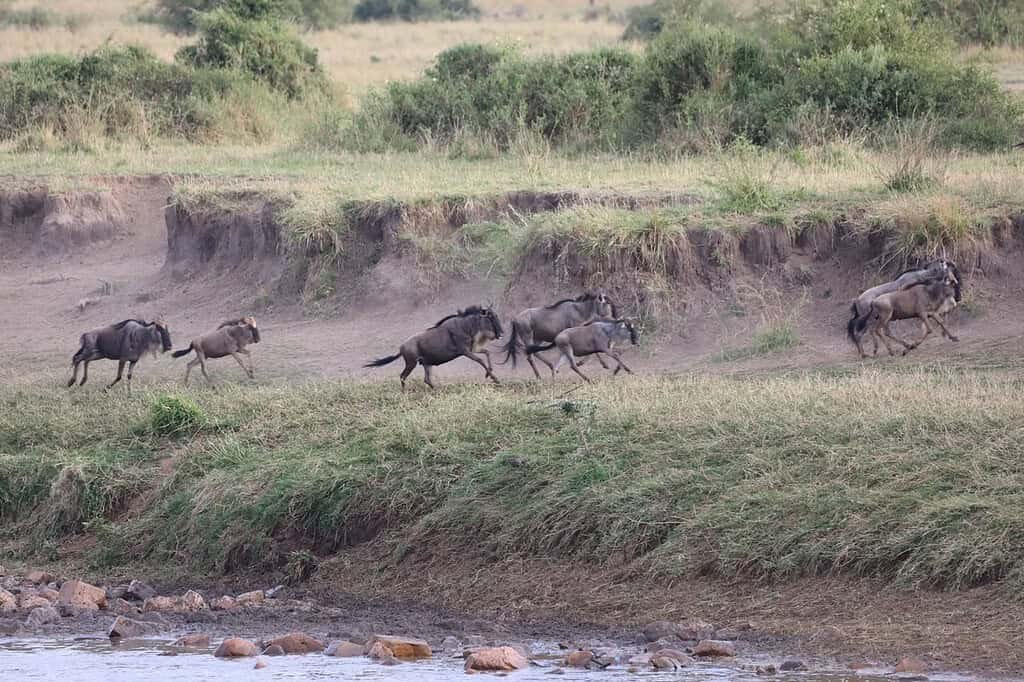
In the first days of the month the herds are usually in the Mara. The main herds arrived early in August 2023; in 2025 large numbers crossed into the Mara Triangle in the first ten days; and in mid-August 2026 about 200,000 animals were in the Triangle. GPS tracking shows that from August to October the Mara River is the herds’ main water source.
Rain often sends them back. In 2024 a storm on the 3rd near Ngiro-are drew thousands of wildebeest into that corner of the Triangle, more rain fell from the 9th to the 16th, and hardly a wildebeest remained in the Mara by the 20th, a month earlier than in 2023. In 2025 very heavy rain from the 9th flooded the river and sent the migration back to Tanzania; within a few days there was hardly a wildebeest in the Mara. In 2026 a storm on the 17th pushed the herds back south. In 2024 and 2025 many came back in September or early October.
The herds also use less of the Mara than they did. In 2024 thousands of wildebeest approached the Talek River but none crossed, and the Mara Conservancy reports that the migration has not reached Mara North and the conservancies for five years or more. It links the change to camps and development along the rivers.
Where can you see river crossings in August?
Crossings happen where the herds meet the rivers, and the herds move between Kenya and Tanzania with the rain. Sites named in recent reports include Look Out and the U crossing on the Mara River into the Mara Triangle, crossing points 7 and 10, Double Crossing and the Sand River; the Mara Conservancy reports next to no crossings now at Main Crossing above Serena. In 2024 Governors’ Camp saw large herds cross into the Triangle below Look Out, with showers pulling them back and forth, and on 17 and 21 August 2025 it saw herds at crossing points 7 and 10 turn south, back into the Serengeti.
Expect company. In the high season more than 1,000 people a day use the toilets at Look Out, the Mara River viewpoint, with queues of up to 70 vehicles at times, the Mara Conservancy reported in 2024 and 2026. Reserve rules ban off-road driving in the Mara River Zone. The Main Reserve had about 14 crossing days in 2025, against 29 in 2024 and about 50 historically, and the Conservancy says most crossings now take place in Tanzania, so allow several days for a chance of a crossing.
What did observers see in the Mara in August?
August 2023. The Mara Conservancy called July and August the driest since it began, with around 5 mm at Serena that month. It was the Triangle’s busiest month on record, with 41,992 visitors; on some days over 600 tourists, in more than 150 vehicles, crossed Mara Bridge into the Triangle. The wildebeest arrived early in the month, and visitor numbers began to fall around the 27th.
August 2024. A storm on the 3rd drew thousands of wildebeest into the Ngiro-are corner of the Triangle, and more rain fell from the 9th to the 16th. The Conservancy called it one of the worst migrations in recent years: the Triangle rarely held more than a few thousand at a time, and hardly a wildebeest remained in the Mara by the 20th. Visitor numbers fell in the last week, much earlier than normal. The two observers saw different things that year: at Musiara, Governors’ Camp recorded 84 mm and large herds across the Talek area and the Posse Plains; by the end of the month, it reported, they were heading north again through Mara Engai.
August 2025. Large numbers of wildebeest crossed into the Triangle in the first ten days. Very heavy rain from the 9th flooded the river and sent the migration back to Tanzania, and nearly all had left the Main Reserve by mid-month. The month started very busy, but numbers dropped in the last week, and the Conservancy expected the season to slow two or three weeks earlier than normal. Governors’ Camp recorded 81 mm and herds at crossing points 7 and 10 turning south on the 17th and 21st.
August 2026. Dry throughout, with occasional showers and one or two storms that did not turn the grass green. About 200,000 animals were in the Triangle in mid-month, until a storm on the 17th pushed the herds back south. The first half of the month was extremely busy, and numbers started dropping in the last week. Keekorok airstrip was closed for repair.
How busy is the Maasai Mara in August?
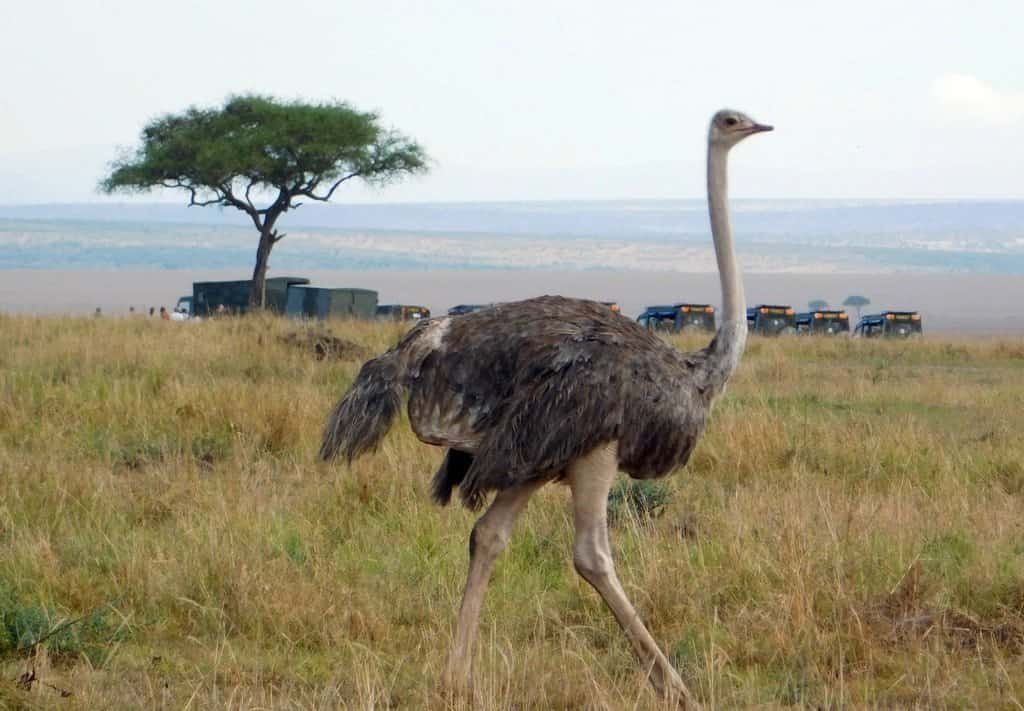
This is the busiest month in the Mara Triangle: it had 41,992 visitors in August 2023, the Mara Conservancy’s record. Counting all non-resident visitors, including those who paid in the Main Reserve, the Triangle had 22,991 in 2023, 13,888 in 2024, 16,718 in 2025 and 14,411 in 2026. In each of those four years the Conservancy reported numbers falling from the last week of the month.
Crowds gather where the herds are. In 2023 over 600 tourists crossed Mara Bridge into the Triangle on some days. The park rules allow a maximum of five vehicles at a lion, leopard, cheetah or rhino sighting, and in the Mara Triangle viewing is restricted to 10 minutes when more than five vehicles are waiting. In 2026 the Kenyan school holiday ran for three weeks to the 21st, and the new term began on the 24th.
How much does a Maasai Mara safari cost in August?
Park fee. This month is in the high season, which runs from 1 July to 31 December. Non-resident adults pay USD 200 a day, children aged 9 to 17 pay USD 50, and children aged 8 and under enter free. Kenyan citizens pay KSh 3,000 and East African residents KSh 5,000 per adult a day; the Mara Triangle charges the same.
Camps. Every camp rate here is in its top season. Published 2026 rates per person per night sharing include USD 500 at Basecamp Masai Mara (with meals and shared drives) and USD 900 at Saruni Mara, both for July–September; USD 547 at Mara West for 1 July–15 September (inclusive package, game drives extra); USD 998 at Governors’ Camp and USD 1,450 at Rekero Camp, both for 1 July–31 October; and USD 1,305 at Ol Seki Hemingways Mara for 1 July–31 August.
Fees on top. Park or conservancy fees are extra at all six: Saruni Mara adds a Mara North conservancy fee of USD 130 or USD 150 per adult a night (confirm with your camp), and Ol Seki Hemingways Mara the Naboisho fee of USD 130 plus a USD 5 Naboisho Reserve Fund fee. Camps inside the Main Reserve may also add a nightly Narok County bed-night or community charge of USD 40–80 per adult; the amount differs between camps, so ask yours.
Extras and packages. In 2026 Governors’ Camp charges USD 512 a day for an exclusive-use vehicle, for up to six guests, from 1 July to 31 October. A shared three-day group safari by road from Nairobi is published at USD 1,200 per person for 16 June–30 September (economy camp), park fees included. Outside the Reserve, by Oloolaimutia Gate, Enchoro Wildlife Camp charges USD 200 per double tent a night, full board, in its 2026 July–September high season, with Reserve fees and game drives extra. Rates ease at some camps from September 2026: Ol Seki Hemingways Mara drops to USD 1,195 on 1 September and Mara West to USD 438 on 16 September.
Residents. Mara Serena Safari Lodge’s 2026 resident ground package costs KSh 43,800 per person for the first night and KSh 39,800 for each extra night from 1 July to 30 September, park fees excluded. Our guide to what a Maasai Mara safari costs has worked budgets for every style.
Can you take a balloon flight in August?
Yes. Governors’ Balloon Safaris publishes 2026 rates of USD 490 per adult for July to October, and USD 275 for a child under 15 all year. On top come Narok County’s landing fee of USD 80 per adult (USD 35 per child), a USD 20 community levy, and USD 5 for medical-evacuation cover if you have none. Children must be at least 8 years old and 1.2 metres tall.
Flights leave at sunrise, between about 6:15 and 6:45 am, and last about an hour, Governors’ Balloon Safaris says; on 95 days out of 100 it flies south over the Mara River. Ask whether the landing fee and the day’s park fee are included in the price you are quoted. Storms can come in this month, and the Reserve’s management plan allows flights to be suspended in unseasonable wet weather, so book the flight early in your stay to leave time to rebook.
Are the camps open in August?
Yes. This is the height of the high season, and the seasonal closures with published dates that we found are in April and May. The Mara Triangle’s seasonal camp, Enkishui, opened from July to November in 2026. Inside the Reserve, the Mara Conservancy counted 55 camps and lodges with 1,701 beds in September 2026, up from 31 in 2016. If you fly in, check which airstrip your camp uses: strips sometimes close for repairs or after heavy rain, and the airline then lands at another one. Ask your camp to confirm your dates.
Is August a good time to visit the Maasai Mara?
- Good for: the migration, which was in the Mara early in the month in each of 2023–2026; river crossings when the herds are on the Mara River; and cool mornings and warm days.
- Less good for: quiet game drives, with crowds at crossings and viewpoints; and budgets, with the high-season park fee and peak camp rates.
- Plan for: storms that can send the herds back to Tanzania within days, as in 2024, 2025 and 2026, and quieter roads from the last week of the month.
Planning an August safari
- Book early: this is the busiest month of the year in the Mara Triangle.
- Budget the high-season park fee: USD 200 per non-resident adult a day.
- Travel in the first half of the month for the best chance of the herds: rain sent them south from the 9th in 2025 and the 17th in 2026.
- Ask your camp where the herds are in the days before you travel.
- Pack a warm layer for mornings of 11–15 °C (recorded at Musiara in 2025) and a light waterproof for storms.
More help choosing your month
- Best time to visit the Maasai Mara – all 12 months compared
- Maasai Mara in September – the next month
- Maasai Mara in July – the month before
- Maasai Mara weather – rain and temperature month by month
- Maasai Mara park fees – rates for every visitor and season
- How much a Maasai Mara safari costs – worked budgets
Thinking of an August safari?
Tell us your dates and what you want to see. MaasaiMara.ke quotes and books safaris through authorised, highly rated tour operator partners, and we will suggest camps that suit the season.
