
Maasai Mara in January: weather, wildlife, crowds and prices
Maasai Mara in January means green plains, the lower park fee and the Mara's resident wildlife, with the migratory herds away in Tanzania for the calving.
January in the Maasai Mara falls in the long rains, but how wet it is changes a lot from year to year: the Mara Triangle measured 272 mm of rain in January 2024 (the monthly report said over 275 mm), 190 mm in 2025 and only 80 mm in 2026. The migratory wildebeest herds are in Tanzania, where calving begins late in the month, so the Mara’s resident wildlife is the draw: its lion prides, cheetahs, elephants, buffalo and giraffe. The park fee is in its low season, USD 100 per non-resident adult a day, and the New Year holiday is busy, mostly with Kenyan visitors.
Park tickets for both the Main Reserve and the Mara Triangle are sold on the KAPS ticket portal.
The observations below come from the Mara Conservancy, which manages the Mara Triangle, and from Governors’ Camp at Musiara, in the north of the Reserve, for each year from 2024 to 2026.
Maasai Mara in January at a glance
Rain: 80–272 mm
Mara Triangle totals for 2024–2026 (the 2024 monthly report said over 275 mm): some years wet, some dry.
Mornings from 14 °C, about 30 °C at midday
Recorded at Governors' Camp, Musiara, in 2024.
Herds in Tanzania
On the southern Serengeti plains; calving begins late in the month.
Low-season park fee
USD 100 per non-resident adult a day, from 1 January to 30 June.
Busy at New Year
Mainly with Kenyan visitors.
Green and long grass
In 2024 Governors' Camp found the grass around the Musiara Marsh almost half a metre tall in places.
What is the weather like in the Maasai Mara in January?
Long-term Mara rain-gauge records count January as part of the long rains (January–June), with wet-season months averaging 96 mm of rain, although the heaviest rain usually falls from March to May. Recent years have swung from very wet to dry. The Mara Triangle measured 272 mm in 2024 (the monthly report said over 275 mm), 190 mm in 2025 and 80 mm in 2026. Governors’ Camp at Musiara recorded 405.5 mm in 2024, 253 mm in 2025 and 33.7 mm in 2026, its driest January since 2017.
Days are warm and mornings cool. Governors’ Camp recorded mornings as low as 14 °C rising to about 30 °C by midday in 2024, and cold, frosty, misty mornings in 2025. Pack a warm layer for early drives and a light waterproof for the rain. Our Maasai Mara weather guide compares every month.
How much rain fell in recent Januaries?
Measured totals for the month, in millimetres, at two gauges in different parts of the Mara.
| Year | Mara Triangle (Serena) | Governors' Camp, Musiara | What it meant |
|---|---|---|---|
| 2024 | 272 (the monthly report said over 275) | 405.5 | The wettest of recent Januaries: roads flooded and balloon flights were suspended from 26 January until the rain eased |
| 2025 | 190, most of it in 10 days of heavy rain | 253 | A dry start, then heavy rain in the last two weeks |
| 2026 | 80 | 33.7, the camp’s lowest for the month since 2017 | A relatively dry month; the Mara River fell towards record lows |
Where is the migration in January?
This month the migratory wildebeest herds are in Tanzania, on the short-grass plains of the southern Serengeti, not in the Mara. Calving begins there late in the month and runs into March, with hundreds of thousands of calves born within a few weeks. The herds usually reach the Mara again in July: see our month-by-month guide for when.
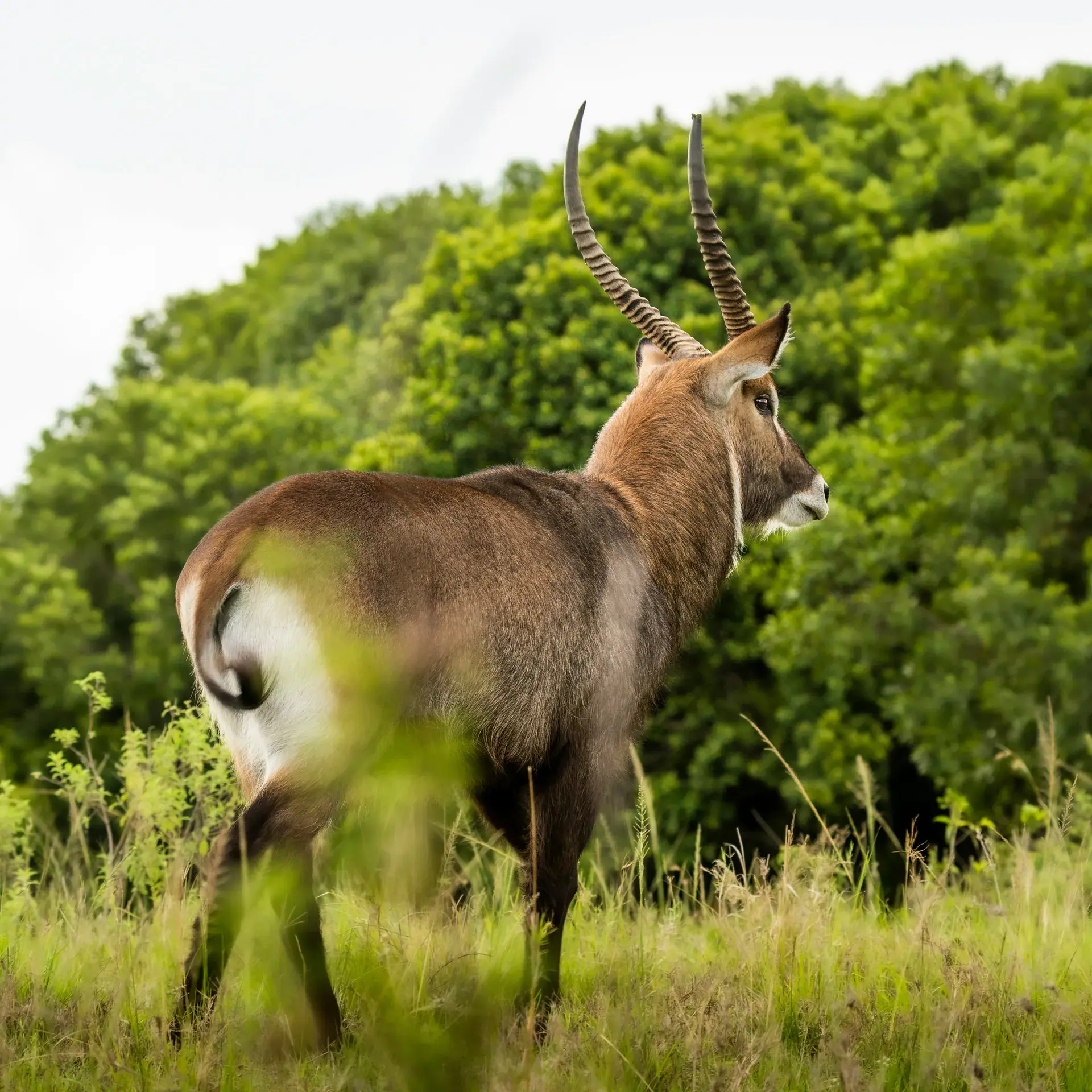
The Mara’s resident wildlife stays all year. Resident lion prides hold the same territories for generations, and lions, leopards, cheetahs, elephants and buffalo breed all year round. In January 2025 Governors’ Camp reported two Marsh Pride lionesses pregnant, large buffalo herds and giraffes with young; a year later the Marsh Pride was active around Bila Shaka.
What did observers see in the Mara in January?
January 2024. The Mara Conservancy reported the whole Mara Triangle under water for most of the month, with off-road driving extremely difficult. Major roads flooded, three vehicles were submerged at the flooded Mugoro crossing and their passengers rescued, and heavy rain on the 16th and 17th cut off parts of the Triangle. Balloon flights were suspended from the 26th until the rain eased. At Musiara, Governors’ Camp saw the Mara River extremely high until late in the month, and grass around the Musiara Marsh almost half a metre tall in places.
January 2025. The Conservancy recorded 10 days of heavy, sustained rain, with sunless, overcast days, drizzle and rain at night; the roads never dried out, and traffic damaged them. One overnight storm near Oloololo flooded the Sabaringo watercourse. Governors’ Camp had a very dry first three weeks that turned the grass golden, then heavy rain in the last two weeks.
January 2026. After an exceptionally dry November, the Conservancy called it a relatively dry month, with the Mara River approaching record lows. Governors’ Camp saw green plains early in the month drying to gold later, while the Musiara Marsh stayed green and saturated.
How busy is the Maasai Mara in January?
The New Year holiday is busy, mainly with Kenyan visitors, and New Year’s Day is a public holiday in Kenya. January and February 2024 were record months for visitors to the Mara Triangle, which had 6,098 overseas visitors in January 2024, the most for any January (the previous high was 4,885 in 2020). For the same month the Conservancy counted 5,303 non-resident adults in 2025 and 5,211 in 2026.
How much does a Maasai Mara safari cost in January?
Park fee. The low season runs from 1 January to 30 June. Non-resident adults pay USD 100 a day, half the July–December fee; children aged 9 to 17 pay USD 50, and children aged 8 and under enter free. Kenyan citizens pay KSh 1,500 and East African residents KSh 2,500 per adult a day.
Camps in the Reserve. Many camps price this month as a mid season, below their peak season. Published 2026 rates per person per night sharing include USD 300 at Basecamp Masai Mara (3 January–February, with meals and shared drives) and USD 623 at Governors’ Camp (1 January–31 March; USD 654 for the same dates in 2027), against USD 500 and USD 998 at the same camps in their 2026 peak seasons. On top of the park fee, camps inside the Main Reserve may add a nightly Narok County bed-night or community charge of USD 40–80 per adult; the amount differs between camps, so ask yours.
Outside the Reserve. On the Oloololo Escarpment, Mara West’s inclusive package (meals and drinks, no game drives; Reserve fees extra) fell from USD 438 to USD 350 per person on 10 January in 2026. Angama Mara’s 2026 rate (safaris, meals and most drinks; park fees extra) fell from USD 2,750 to USD 1,850 on 5 January; its 2027 rate from that date is USD 2,450.
Conservancy camps. Published 2026 rates include USD 700 at Saruni Mara (3 January–February) and USD 730 at Kicheche Mara Camp, both in the Mara North Conservancy, and USD 840 at Kicheche Bush Camp in the Olare Motorogi Conservancy (both Kicheche camps 3 January–28 February), against USD 900, USD 995 and USD 1,095 in their peak seasons. These three camps add a nightly conservancy fee of USD 130 per adult in 2026, but some Mara North camps quote USD 150, so confirm it with your camp. Kandili Camp, in the Leopard Gorge Conservancy, charges USD 300 full board from 7 January to 31 March 2026, plus a conservancy fee of USD 50 per adult a day.
Packages. A shared three-day group safari by road from Nairobi is published from USD 840 per person (economy camp) for 3 January–31 March, park fees included. Our guide to what a Maasai Mara safari costs has worked budgets for every style.
Can you take a balloon flight in January?
Yes, though rain can stop the flights. Governors’ Balloon Safaris publishes 2026 prices of USD 430 per adult for January to March, and USD 275 for a child under 15. On top come Narok County’s landing fee of USD 80 per adult (USD 35 per child), a USD 20 community levy, and USD 5 for medical-evacuation cover if you have none. Children must be at least 8 years old and 1.2 metres tall.
In 2024, the wettest January in recent years, the Mara Conservancy reported balloon flights suspended from the 26th until the rain eased. If a balloon flight matters to you, plan it early in your stay so there is time to rebook.
Are the camps open in January?
The seasonal camp closures we found are in the long rains of April and May. The Mara Triangle’s seasonal camp, Enkishui, opens only from July to November. Some closures are one-offs: in January 2026, Little Governors’ camp in the Triangle was closed for a complete makeover, with reopening planned for June 2026. By July 2026 the Conservancy listed it as Mara Wilderness. Ask your camp whether it is open for your dates.
Is January a good time to visit the Maasai Mara?
- Good for: the low-season park fee and mid-season camp rates, green landscapes, the Mara’s resident big cats and fewer vehicles than in the migration months.
- Less good for: the wildebeest migration, which is in Tanzania; and in a wet year, flooded roads, muddy tracks and long grass.
- Plan for: busy days around New Year, and rain that varies from almost none to several hundred millimetres in a month.
Planning a January safari
- Book early if you are travelling over New Year, the busiest part of the month.
- Pack a warm layer for cool mornings and a light waterproof for the rain.
- Budget the low-season park fee: USD 100 per non-resident adult a day.
- Ask your camp how recent rain has affected the roads and river crossings.
- If you want to see the calving herds, plan a trip to Tanzania's southern Serengeti instead.
More help choosing your month
- Best time to visit the Maasai Mara – all 12 months compared
- Maasai Mara in February – the next month
- Maasai Mara in December – the month before
- Maasai Mara weather – rain and temperature month by month
- Maasai Mara park fees – rates for every visitor and season
- How much a Maasai Mara safari costs – worked budgets
Thinking of a January safari?
Tell us your dates and what you want to see. MaasaiMara.ke quotes and books safaris through authorised, highly rated tour operator partners, and we will suggest camps that suit the season.
