
Maasai Mara in May: weather, wildlife, crowds and prices
Maasai Mara in May means the last of the long rains, one of the quietest months of the year and the lower park fee, with the migratory herds starting to move west in Tanzania.
May in the Maasai Mara is the last month of the long rains, and how wet it is varies: the Mara Triangle measured 156.81 mm of rain in May 2024, the month of the Talek River floods, while Governors’ Camp at Musiara recorded only 21 mm in 2026, an unusually dry month. The migratory wildebeest herds are leaving the southern Serengeti and moving west in Tanzania, so the Mara’s resident wildlife is the draw. The park fee is in its low season, USD 100 per non-resident adult a day, until 30 June, and this is one of the quietest months, though the second half can be busy.
Park tickets for both the Main Reserve and the Mara Triangle are sold on the KAPS ticket portal.
The observations below come from the Mara Conservancy, which manages the Mara Triangle, and from Governors’ Camp at Musiara, in the north of the Reserve, for each year from 2024 to 2026.
Maasai Mara in May at a glance
The last of the long rains
Musiara recorded 112 mm in 2024 and only 21 mm in 2026; the Mara Triangle had 156.81 mm in 2024.
Some camps closed
Rekero Camp is closed in April and May, and Encounter Mara in May; both reopen in June.
Herds moving west
Leaving the southern Serengeti plains in Tanzania; not yet in the Mara.
Low-season park fee
USD 100 per non-resident adult a day until 30 June; USD 200 from 1 July.
Quiet, then busier
Usually the month with the lowest revenue, but the second half was very busy in 2026.
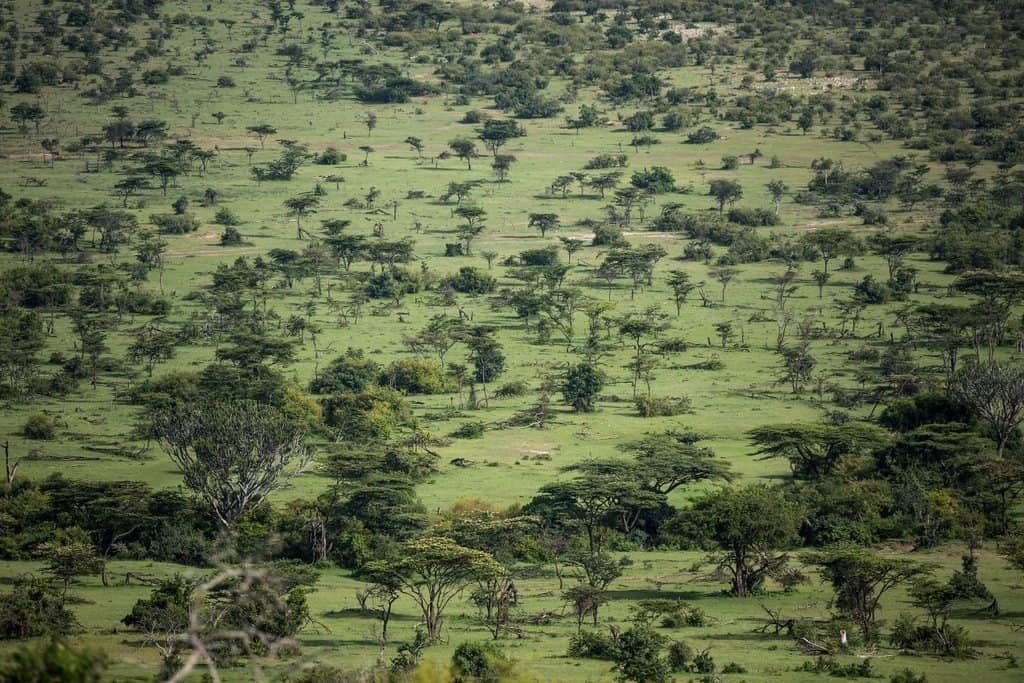
Long grass
Governors' Camp reported long grass in 2025 and 2026; in 2024 the red oat grass was in seed and turning golden.
What is the weather like in the Maasai Mara in May?
The long rains usually run from March to May, with the wettest spell in April, and long-term Mara rain-gauge records put wet-season months at an average of 96 mm of rain. The Mara Triangle measured 156.81 mm in 2024 (the monthly report said around 160 mm at Serena, and much more elsewhere); by the end of that month it had had a full year’s rainfall, just under 1,000 mm, in five months. The Conservancy gave no total for 2025, and in 2026 it rained only in the first half of the month.
Governors’ Camp at Musiara recorded 112 mm in 2024, mostly in the first two weeks; for 2025 its May report gives 163.5 mm and its June report 168.5 mm; and in 2026 it had only 21 mm, an unusually dry month in which the plains dried quickly. Our Maasai Mara weather guide compares rain and temperature month by month.
Rain affects travel too. Light aircraft land on unsealed bush airstrips, and Airkenya says flights in the long rains can be briefly delayed or re-routed when visibility at an airstrip falls below safety minimums; strips sometimes close after heavy rain or for repairs, and the airline then lands at another one. Pack a light waterproof.
How much rain fell in recent Mays?
Measured totals for the month, in millimetres, at two gauges in different parts of the Mara.
| Year | Mara Triangle (Serena) | Governors' Camp, Musiara | What it meant |
|---|---|---|---|
| 2024 | 156.81 (the monthly report said around 160) | 112, mostly in the first two weeks | On the 1st the Talek River burst its banks, damaging at least 20 camps and lodges along it |
| 2025 | No total | 163.5 (the camp’s May report) or 168.5 (its June report) | Long grass and a fairly high Mara River |
| 2026 | No total: rain only in the first half | 21, an unusually dry month | Excellent weather and outstanding game viewing after mid-month |
The 2024 Mara Triangle figure comes from the Conservancy’s year-end rain chart, which is titled “Rainfall 2025” but holds the 2024 data.
Where is the migration in May?
This is the month the migratory wildebeest herds leave the southern Serengeti plains in Tanzania. With the dry season from May they move west, towards the Western Corridor in June and July, then north; GPS tracking puts the median move away from the wet-season range between 6 May and 29 June. They are not yet in the Mara, and usually arrive in July: see our month-by-month guide for when.
You can still see wildebeest in the Mara this month. Many animals of Kenya’s own, smaller Mara-Loita herd, about 26,700 wildebeest in 2024, now stay in the conservancies north and east of the Reserve. In 2025 Governors’ Camp saw resident wildebeest and zebra widely at Musiara, and in 2026 the Mara Conservancy reported burnt areas drawing large numbers of Thomson’s gazelle, topi, zebra and herds of wildebeest.
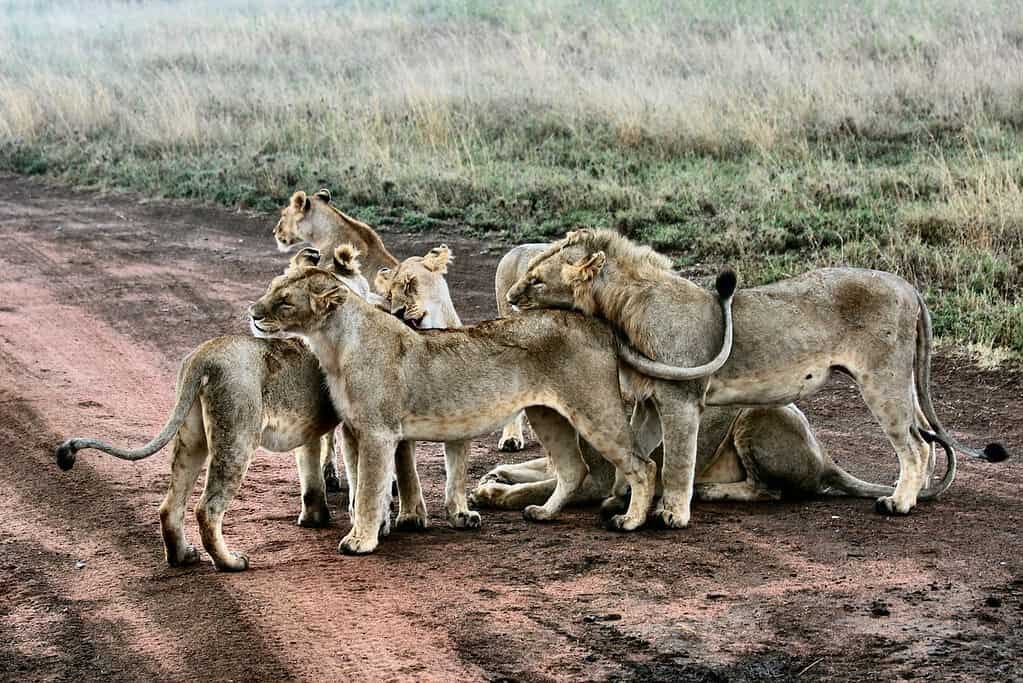
The resident wildlife stays all year. Resident lion prides hold the same territories for generations, and the big cats breed all year round. Governors’ Camp reported Lola of the Marsh Pride with two newborn cubs around the end of May 2025, and Kito of the same pride with a newborn cub in mid-May 2026.

What did observers see in the Mara in May?
May 2024. On the 1st the Talek River burst its banks, the Mara Conservancy and Governors’ Camp reported: at least 20 camps and lodges along it were damaged, some tents were washed away and at least 40 people were rescued. The upper bridge at Purungat (Mara Bridge) was swept away, so road traffic could not cross there between the Main Reserve and the Triangle until the lower bridge opened on 25 July 2024. More storms followed from the 13th.
Governors’ Camp recorded 112 mm, mostly early in the month, and its Mara camps did not flood. The long red oat grass was in seed and turning golden, zebra and other plains grazers had moved out to the Mara North Conservancy, and over 40 hyenas gathered at a hippo carcass on the 22nd. Elewana’s Sand River camp closed temporarily after the floods, reopened with seven tents at Little Sand River and planned to reopen fully by 10 June 2024.
May 2025. The Conservancy had a third month in a row with very little revenue: non-resident visitors for January to April fell from 19,785 in 2024 to 14,992. Numbers picked up slightly in the last week of the month, with June expected to be busy as people used the lower fees before the July increase. Governors’ Camp recorded 163.5 mm in its May report (168.5 mm in its June report), with long grass, a fairly high Mara River and resident wildebeest and zebra widely seen.
May 2026. Rain fell in the first half of the month, then the Conservancy reported excellent weather and outstanding game viewing, with burnt areas drawing large numbers of Thomson’s gazelle, topi, zebra and herds of wildebeest. The second half was very busy, probably busier than in 2025. Governors’ Camp recorded only 21 mm; the plains dried quickly, the grass was long and visibility superb, and a newborn giraffe was seen at Double Crossing.
How busy is the Maasai Mara in May?
This is normally one of the quietest months: the Mara Conservancy calls April and May the quietest months of the year, and May is usually its month with the lowest revenue. The second half can be busy, though. The high season started picking up late in the month in 2024, and the second half was very busy in 2026. That May the Mara Triangle had 8,169 visitors in all, of whom 4,118 did not pay there: 2,132 had paid elsewhere, 1,080 were in transit, and 906 were students, researchers or complimentary visitors.
Labour Day, 1 May, is a Kenyan public holiday. June has become busy, as visitors use the lower park fees before the high-season increase on 1 July.
How much does a Maasai Mara safari cost in May?
Park fee. May is in the low season, which runs from 1 January to 30 June. Non-resident adults pay USD 100 a day, half the July–December fee; children aged 9 to 17 pay USD 50, and children aged 8 and under enter free. Kenyan citizens pay KSh 1,500 and East African residents KSh 2,500 per adult a day.
Camps in the Reserve. April and May are the cheapest months at many camps. Published 2026 rates per person per night sharing include USD 300 at Basecamp Masai Mara (low season, March–May, with meals and shared drives), USD 453 at Governors’ Camp and USD 667 at Governors’ Il Moran Camp (both 1 April–31 May), against USD 500, USD 998 and USD 1,592 at the same camps in their peak seasons. On top of the park fee, camps inside the Main Reserve can add a nightly Narok County bed-night or community charge of USD 40–80 per adult; the amount differs between camps, so ask yours.
Outside the Reserve. Kilima Camp, on the Oloololo Escarpment, charges from USD 305 full board in its 2026 low season (April–May) and from USD 475 in its high season, and Mara West charges USD 350 for its inclusive package (meals and drinks, no game drives) from 10 January to 15 June 2026, against USD 547 at peak; at Mara West, Reserve fees are extra.
Conservancy camps. In 2026 Saruni Mara charges USD 500 and Offbeat Mara Camp USD 580 (both March–May), and Kicheche Mara Camp, closed until 22 May in 2026, then charges USD 625, against USD 900, USD 950 and USD 995 in their peak seasons. These camps add a Mara North conservancy fee, quoted at USD 130 or USD 150 per adult a night in 2026; confirm it with your camp.
Packages and extras. A shared three-day group safari by road from Nairobi is published at USD 795 per person for 1 April–31 May (economy camp), park fees included. A balloon flight with Governors’ Balloon Safaris is USD 400 per adult in April–May 2026, plus a USD 80 landing fee and a USD 20 community levy. Our guide to what a Maasai Mara safari costs has worked budgets for every style.
Are the camps open in May?
Several camps close this month. Rekero Camp, on the Talek River, is closed in April and May, and Encounter Mara, in the Naboisho Conservancy, is closed in May; both open again from June. Porini Mara Camp and Porini Cheetah Camp close for one month, and Porini Lion Camp for four weeks, in the rainy season, without saying which month. Naboisho Camp is open all year.
For 2026, Kicheche Mara Camp and Ol Seki Hemingways Mara were closed until 22 May, and Kicheche Valley Camp until 31 May. Little Governors’ camp in the Triangle, closed for a complete makeover, was planned to reopen in June 2026; by July 2026 the Conservancy listed it as Mara Wilderness. Floods can also close camps at short notice, as on the Talek River in 2024. Ask your camp whether it is open for your dates.
Is May a good time to visit the Maasai Mara?
- Good for: one of the quietest months of the year, the low-season park fee and the lowest rates at many camps, and the Mara’s resident wildlife, including newborn Marsh Pride lion cubs seen in 2025 and 2026.
- Less good for: the wildebeest migration, which is still in Tanzania; camps that close for the rains; and in a wet year, flooding like the Talek River floods of 2024.
- Plan for: the last of the long rains, busier days in the second half, and booking ahead for late May, when the high season can start to pick up.
Planning a May safari
- Check that your camp is open: several close for part or all of the month.
- Pack a light waterproof: this is the last month of the long rains.
- Budget the low-season park fee: USD 100 per non-resident adult a day, until 30 June.
- Ask your camp how recent rain has affected the roads, bridges and river crossings.
- Flying on to the Serengeti? In Airkenya's 2026 timetable, its daily connection from the Mara, via Migori and Tarime, does not run from 1 April to 20 May.
- If you want to see the migratory herds in the Mara, they usually arrive in July.
More help choosing your month
- Best time to visit the Maasai Mara – all 12 months compared
- Maasai Mara in June – the next month
- Maasai Mara in April – the month before
- Maasai Mara weather – rain and temperature month by month
- Maasai Mara park fees – rates for every visitor and season
- How much a Maasai Mara safari costs – worked budgets
Thinking of a May safari?
Tell us your dates and what you want to see. MaasaiMara.ke quotes and books safaris through authorised, highly rated tour operator partners, and we will suggest camps that suit the season.
